
Whether you’re demolishing reinforced concrete, breaking asphalt, renovating industrial facilities, or carrying out road maintenance, selecting the right demolition equipment can determine the success of your project.
In the UAE, construction projects operate under demanding conditions. Contractors work in high temperatures, strict project timelines, and environments where equipment reliability is essential. Downtime is expensive, labour costs continue to rise, and every delay impacts project completion.
From our experience at Liberty Enterprises LLC, one thing has remained consistent over the years: the contractors who invest in the right demolition equipment complete projects faster, reduce operating costs, and experience fewer equipment failures.
Choosing demolition equipment is not simply about buying the biggest or most powerful machine. It is about selecting the right tool for the application, the material, the working conditions, and the available infrastructure on site.
In this guide, we’ll explain how professional contractors choose demolition equipment, the different types of pneumatic tools available, and why working with an experienced demolition equipment supplier in UAE makes a significant difference over the life of a project.
When contractors purchase demolition equipment, they are not just buying a machine.
They are investing in:
A supplier who only delivers equipment without understanding the application often leaves customers with tools that are either oversized, undersized, or unsuitable for the job.
An experienced supplier asks different questions.
Before recommending equipment, they typically want to know:
These questions help identify the most suitable solution instead of simply recommending the most expensive one.
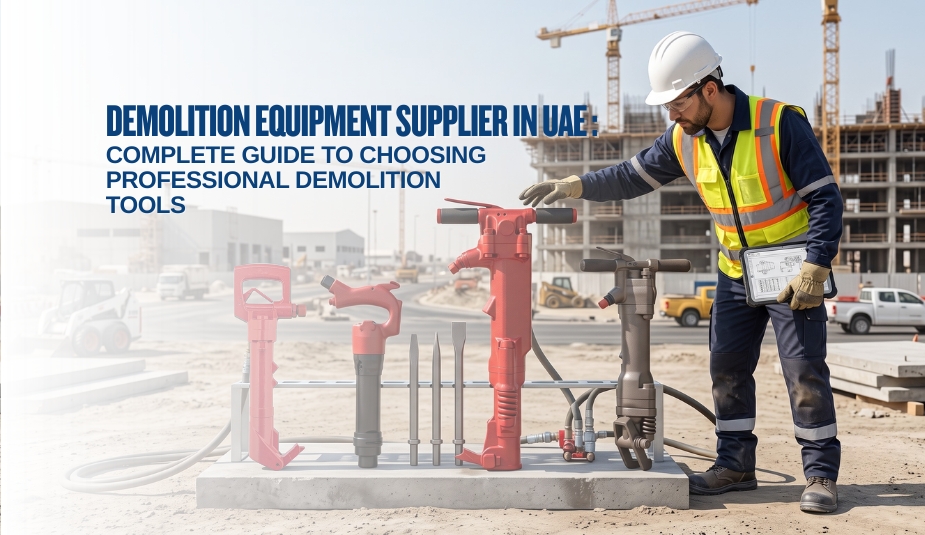
Demolition equipment is available in many forms, and each tool is designed for a specific application.
Selecting the wrong tool often results in lower productivity and increased operating costs.
Pneumatic breakers are among the most widely used demolition tools in professional construction.
Powered by compressed air, they deliver continuous impact energy capable of breaking reinforced concrete, asphalt, rock, and heavy foundations.
Professional contractors choose pneumatic breakers because they are designed for continuous operation under demanding site conditions.
At Liberty Enterprises LLC, we supply a complete range of pneumatic breakers suitable for construction, infrastructure, and industrial projects.
You can explore our collection here:
Paving breakers are heavy-duty pneumatic tools specifically designed for breaking roads, pavements, reinforced concrete, and large foundations.
Unlike lighter demolition tools, paving breakers deliver significantly greater impact energy and are commonly found on:
For contractors handling large demolition projects, the ACE PB1240 Paving Breaker is designed for demanding applications requiring continuous performance.
For medium-duty construction work, the ACE PB1230 Paving Breaker offers an excellent balance of impact power, durability, and operator control.
For general-purpose demolition work, the ACE PB777 Paving Breaker provides dependable pneumatic performance across a wide range of construction applications.
While pneumatic breakers are designed for large-scale demolition, chipping hammers are built for precision work.
They are commonly used for:
Choosing a chipping hammer instead of a heavy breaker can improve operator control and reduce unnecessary damage during repair work.
Certain applications require lighter pneumatic tools capable of excavation and precision breaking.
The ACE CD222 Clay Digger is ideal for:
Learn more here:
Professional demolition equipment is used across almost every construction-related industry.
Some of the most common sectors include:
Construction contractors use pneumatic demolition equipment during:
Reliable demolition equipment improves productivity while reducing labour requirements.
Infrastructure projects frequently involve:
Heavy-duty paving breakers remain one of the preferred solutions because of their durability and continuous impact performance.
Factories and industrial plants regularly require demolition equipment during shutdowns and maintenance projects.
Typical applications include:
Because shutdown schedules are often limited, contractors require equipment that performs reliably without unexpected downtime.
Marine maintenance contractors also rely on pneumatic demolition equipment for:
These demanding environments require robust pneumatic tools capable of operating under harsh conditions.
Not every industrial equipment supplier specialises in demolition tools.
Professional suppliers typically offer more than product availability.
They provide:
For contractors, this level of support often becomes just as valuable as the equipment itself.
Over the years, we’ve found that customers rarely return because they bought the cheapest tool. They return because the equipment performed reliably, spare parts were readily available, and technical support was there when they needed it.
That long-term relationship is what separates a professional demolition equipment supplier from a company that simply sells industrial products.
Every demolition project has unique requirements. A contractor removing a reinforced concrete bridge deck requires very different equipment from a maintenance team repairing damaged concrete inside a factory.
Rather than selecting equipment based solely on price or size, professional contractors usually evaluate five key factors before making a purchase.
The material determines the type of equipment required.
For example:
Matching the equipment to the material improves productivity while reducing unnecessary wear on the tool.
One of the first questions we ask customers is:
“How long will the equipment be running each day?”
A breaker used occasionally for maintenance has very different requirements from one operating eight hours a day on a highway project.
For continuous industrial applications, contractors generally choose heavy-duty pneumatic breakers because they are built to withstand demanding workloads.
Pneumatic demolition equipment depends entirely on compressed air.
Before purchasing any pneumatic breaker, contractors should confirm that their compressor can provide:
An undersized compressor reduces tool performance regardless of how powerful the breaker itself may be.
Many buyers focus only on initial cost.
Experienced procurement teams look at the total cost of ownership.
This includes:
A lower-priced breaker that fails during a critical project can ultimately cost far more than investing in professional-grade equipment from the start.
The best equipment recommendations come from suppliers who understand construction and industrial applications—not just product catalogues.
A knowledgeable supplier will recommend equipment based on the application, not simply the highest-priced model.
Pneumatic breakers remain one of the most versatile demolition tools available.
They are commonly used for:
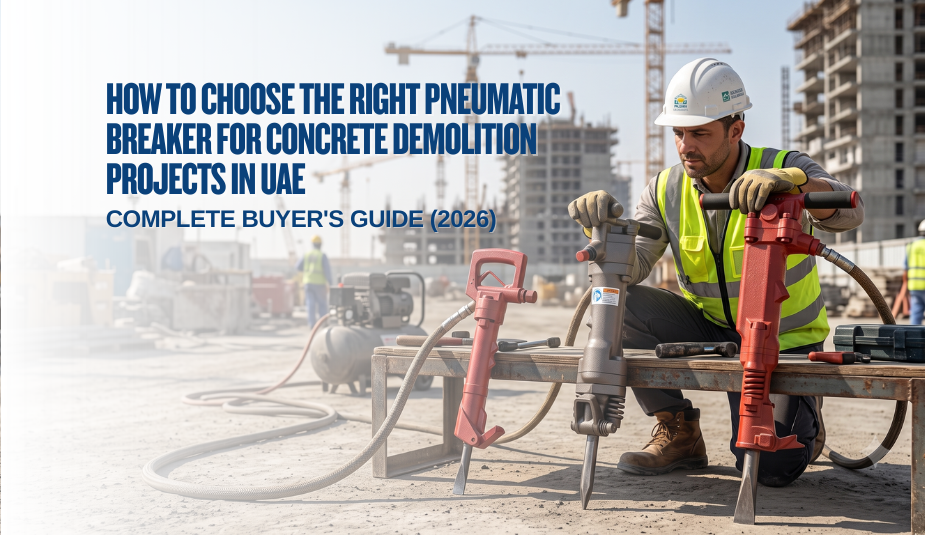
If you’re comparing different models, our guide on How to Choose the Right Pneumatic Breaker for Concrete Demolition Projects in UAE explains how contractors evaluate breaker size, impact force, compressor requirements, and project suitability before making a purchase.
For projects involving reinforced concrete and heavy demolition, the ACE PB1240 Paving Breaker is engineered for demanding applications requiring continuous performance.
For medium-duty demolition work, the ACE PB1230 Paving Breaker provides an excellent balance between impact energy and operator control.
Where versatility is important, the ACE PB777 Paving Breaker offers dependable performance across a wide range of construction and maintenance applications.
For lighter excavation and utility work, the ACE CD222 Clay Digger provides a compact pneumatic solution for contractors working in restricted areas.
Many contractors use the terms jack hammer, pneumatic breaker, air breaker, and paving breaker interchangeably.
While these terms often describe similar categories of pneumatic demolition equipment, selecting the correct tool still depends on the application.
For lighter repair work and surface preparation, a chipping hammer provides better precision.
For heavy demolition, reinforced concrete, and road breaking, pneumatic breakers deliver the impact energy required for continuous industrial work.
If you’re unsure which tool best suits your project, read our detailed guide:
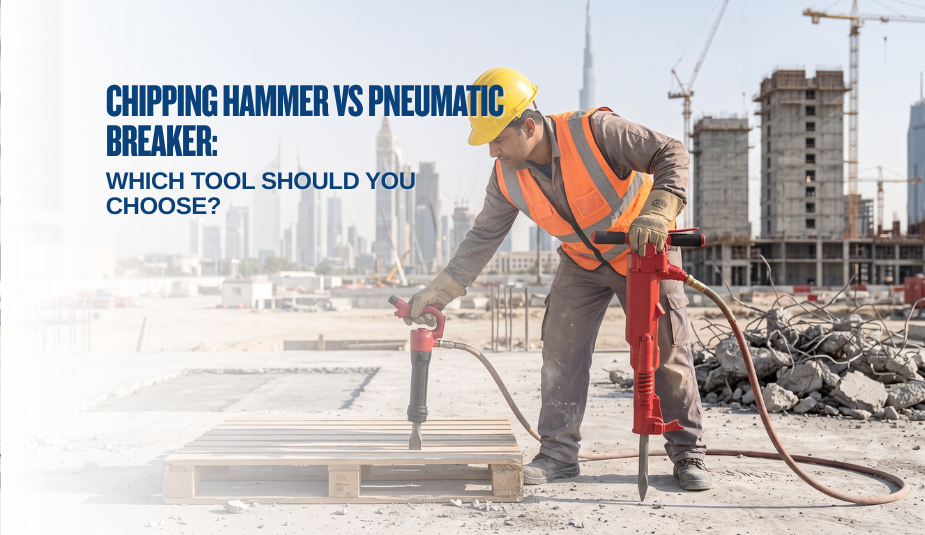
Chipping Hammer vs Pneumatic Breaker: Which Tool Should You Choose?
This comparison explains the strengths of each tool and helps contractors avoid purchasing equipment that doesn’t match their requirements.
After supplying demolition equipment to contractors across the UAE, we’ve noticed several recurring mistakes.
A larger breaker is not always the better option.
Oversized equipment can increase:
The objective is to choose equipment that matches the application—not simply the largest available model.
Trying to save money by selecting a smaller breaker often has the opposite effect.
An undersized breaker can lead to:
Professional contractors calculate productivity over the entire project rather than comparing purchase prices alone.
Construction equipment eventually requires servicing.
Before purchasing demolition equipment, contractors should ask:
Reliable after-sales support can significantly reduce project downtime.
The UAE construction industry operates in demanding conditions.
High temperatures, dust, long working hours, and fast-paced project schedules require equipment capable of delivering reliable performance every day.
Professional pneumatic demolition equipment offers several advantages:
These qualities make pneumatic breakers a preferred choice for contractors involved in infrastructure, commercial construction, road maintenance, and industrial projects throughout the UAE.
At Liberty Enterprises LLC, we don’t simply supply industrial equipment—we work closely with contractors, engineers, procurement teams, and maintenance companies to recommend the right solution for each application.
Our product range includes professional pneumatic demolition equipment designed for demanding environments across construction, infrastructure, marine, and industrial sectors.
Customers choose us because we provide:
Our goal is to help customers invest in equipment that improves productivity and delivers long-term value.
Heavy-duty pneumatic breakers are generally the preferred choice for reinforced concrete because they provide high impact energy and are designed for continuous operation.
The terms are often used interchangeably within the construction industry. A paving breaker usually refers to a heavy-duty pneumatic breaker designed for road construction, reinforced concrete, and asphalt demolition.
Road contractors commonly use heavy-duty pneumatic paving breakers because they are specifically designed for asphalt removal, pavement repairs, and infrastructure projects.
Consider:
Selecting the correct breaker improves efficiency and reduces overall project costs.
Yes. Liberty Enterprises LLC supplies professional pneumatic demolition equipment to contractors, construction companies, industrial facilities, marine operators, and infrastructure projects throughout the UAE.
Selecting demolition equipment is about much more than buying a machine.
It is about choosing a solution that matches your project requirements, improves productivity, minimises downtime, and delivers long-term value.
Whether you’re breaking reinforced concrete, removing asphalt, renovating industrial facilities, or carrying out infrastructure maintenance, professional pneumatic demolition equipment remains one of the most reliable choices for demanding applications.
At Liberty Enterprises LLC, we help contractors and procurement teams identify the right equipment based on real project requirements—not sales targets.
Explore our complete range of Pneumatic Breakers to find the right solution for your next demolition project, or contact our team for expert technical guidance on selecting the most suitable equipment for your application.