
Choosing the right demolition equipment can have a major impact on project productivity, labour efficiency, and overall cost.
In construction and industrial environments, two tools are often compared:
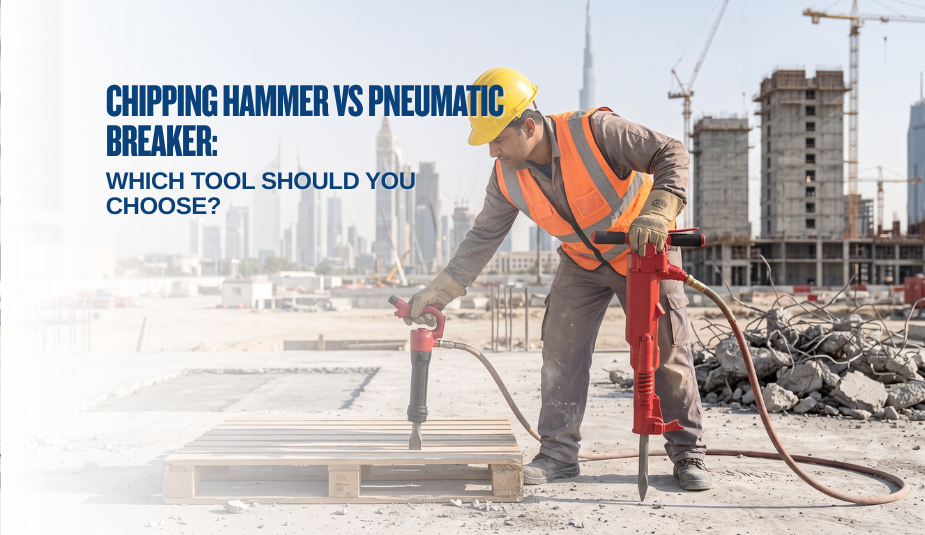
Although both tools use compressed air and are designed for breaking materials, they serve very different purposes.
A common mistake among contractors and purchasing teams is assuming that a larger tool is always better. In reality, selecting the wrong demolition tool can result in unnecessary labour, slower progress, increased operator fatigue, and higher equipment costs.
At Liberty Enterprises LLC, we work with construction companies, contractors, maintenance teams, and industrial customers across the UAE. Through our experience supplying pneumatic demolition equipment, we have seen that the best results come when the tool is matched correctly to the application.
A chipping hammer and a pneumatic breaker are not competing tools.
They are designed for different jobs.
Understanding the difference helps contractors choose equipment that delivers the right balance of power, control, and productivity.
A chipping hammer is a lightweight pneumatic tool designed for precision demolition and surface removal work.
Unlike heavy-duty paving breakers, chipping hammers are built for controlled applications where accuracy and manoeuvrability are more important than maximum impact force.
They are commonly used for:
Because of their compact size, chipping hammers allow operators to work in areas where larger demolition tools would be difficult to control.
Typical users include:
A pneumatic breaker, also known as an air breaker, pneumatic jack hammer, or paving breaker, is a heavy-duty demolition tool powered by compressed air.
These machines are designed to deliver powerful repeated impact for breaking hard materials such as:
Pneumatic breakers are commonly used in:
For contractors handling demanding applications, pneumatic breakers provide the durability and impact energy required for continuous operation.
You can explore Liberty Enterprises’ complete range of Pneumatic Breakers designed for professional construction and demolition applications in UAE.
The biggest difference between these tools is their intended application.
A chipping hammer focuses on:
A pneumatic breaker focuses on:
Choosing between them depends on the type of material, project requirements, and working conditions.
Chipping hammers are widely used in concrete repair applications.
Examples include:
In these situations, precision is more important than brute force.
A large pneumatic breaker may damage surrounding areas, while a chipping hammer allows operators to remove only the required material.
Chipping hammers are also valuable in marine and industrial environments.
They are commonly used for:
For shipyards, workshops, and maintenance contractors, having compact pneumatic tools available can significantly improve efficiency.
For smaller demolition tasks, a chipping hammer can be more practical than a large breaker.
Examples include:
The operator gets better control while reducing unnecessary equipment handling.
When the project involves thick concrete, reinforced structures, or large demolition areas, pneumatic breakers become the preferred choice.
They are designed for:
Heavy-duty pneumatic breakers provide the impact force needed to maintain productivity during demanding applications.
Road contractors commonly use pneumatic breakers because asphalt and pavement require consistent impact energy.
Applications include:
For these applications, professional contractors often select heavy-duty paving breakers.
The ACE PB1240 Paving Breaker is designed for demanding applications where contractors require reliable performance for concrete and asphalt breaking.
Industrial facilities often require demolition equipment that can operate under challenging conditions.
Examples include:
In these environments, downtime can be extremely expensive, making reliable pneumatic equipment an important investment.
Understanding the technical differences between these tools helps contractors and procurement teams select the correct equipment for their project.
The biggest difference between a chipping hammer and a pneumatic breaker is impact energy.
A chipping hammer delivers controlled impact suitable for removing smaller amounts of material. It allows the operator to work carefully without damaging surrounding areas.
A pneumatic breaker delivers significantly higher impact force and is designed to fracture large volumes of concrete, asphalt, and rock.
For example:
Choosing the correct impact level prevents unnecessary equipment strain and improves productivity.
Chipping hammers are lightweight and designed for better operator control.
Their advantages include:
Pneumatic breakers are heavier because they are built for maximum breaking performance.
Their weight helps transfer more impact energy into hard materials, making them suitable for heavy-duty applications.
The expected working duration is another important consideration.
For short maintenance activities, a chipping hammer is often sufficient.
For projects involving several hours of continuous demolition, a pneumatic breaker is usually the better option.
Professional contractors select equipment based on the complete project lifecycle rather than only the first day of use.
The thickness and hardness of the material being removed should always influence equipment selection.
Using a chipping hammer on heavy concrete demolition can significantly reduce productivity.
Before selecting demolition equipment, contractors should evaluate several factors.
Project scale is usually the first indicator.
For small repair work:
A chipping hammer provides better control and efficiency.
For large construction and infrastructure projects:
A pneumatic breaker is usually the correct choice because it is designed for higher workloads.
Concrete strength varies significantly.
A lightweight tool may work perfectly on normal concrete but struggle with:
Understanding the material before choosing equipment avoids delays on site.
Both tools require compressed air, meaning compressor compatibility is important.
Before selecting equipment, check:
A properly matched compressor ensures consistent performance.
Operator comfort matters, especially during long working hours.
A heavier tool provides more breaking power but requires more physical control.
A lighter tool improves handling but may not provide enough force for demanding demolition.
The correct choice balances productivity and operator efficiency.
At Liberty Enterprises LLC, we supply pneumatic demolition tools suitable for different construction and industrial requirements.
The correct model depends on the application rather than simply choosing the largest available tool.
For contractors working on:
a heavy-duty paving breaker is usually the ideal solution.
The ACE PB1240 Paving Breaker is designed for demanding demolition applications where reliability and continuous performance are required.
It is suitable for contractors who need a robust pneumatic breaker capable of handling tough materials and extended working hours.
Some projects require a balance between power and portability.
Applications include:
The ACE PB1230 Paving Breaker provides contractors with dependable pneumatic performance for various construction applications.
It offers a practical solution where a heavy industrial breaker may not be necessary.
For lighter applications requiring better control, compact pneumatic tools are often preferred.
Examples include:
The ACE CD222 Clay Digger is designed for applications where operators need pneumatic power in a lighter and more manageable format.
For contractors requiring reliable performance across multiple applications, the ACE PB777 Paving Breaker provides a versatile pneumatic solution.
It is suitable for general construction work where dependable breaking performance is required.
A bigger tool does not always mean better results.
Oversized equipment can:
The best equipment is the one that matches the application.
The opposite mistake is selecting equipment that is too small.
A lightweight breaker used for heavy demolition can result in:
Professional contractors calculate total productivity, not only purchase price.
Pneumatic tools require proper maintenance to achieve maximum service life.
Important maintenance practices include:
Working with a supplier that understands industrial equipment and provides technical support can significantly reduce downtime.
The UAE environment creates additional challenges for construction equipment.
Dust, heat, and long operating hours can affect tool performance.
To maintain reliable operation:
Pneumatic tools require proper lubrication to protect internal components.
Insufficient lubrication can increase wear and reduce equipment life.
Compressed air quality directly affects pneumatic tool performance.
Always check:
Chisels and points experience significant wear during demolition.
A worn accessory reduces efficiency and forces the operator to apply more pressure.
Replacing worn accessories improves productivity and protects the equipment.
No. While both tools use compressed air, they are designed for different applications. Chipping hammers are used for precision work and light demolition, while pneumatic breakers are designed for heavy-duty concrete and asphalt breaking.
For large-scale concrete demolition, pneumatic breakers are generally the better choice because they provide higher impact energy and are designed for continuous operation.
Yes, but only for smaller concrete removal tasks. For thick concrete slabs, foundations, or reinforced concrete, a pneumatic breaker is more suitable.
Yes. Pneumatic breakers are widely used across UAE construction, infrastructure, road, and industrial projects because they perform well under demanding working conditions.
A pneumatic breaker may also be called a pneumatic jack hammer, air breaker, paving breaker, or concrete breaker depending on the industry and region.
Choosing between a chipping hammer and a pneumatic breaker comes down to understanding the application.
A chipping hammer is the right choice when you need:
A pneumatic breaker is the better choice when you need:
For UAE contractors, construction companies, and industrial maintenance teams, selecting the correct demolition equipment can have a direct impact on project efficiency and operating costs.
At Liberty Enterprises LLC, we help customers choose pneumatic demolition equipment based on their actual requirements, including material type, project duration, compressor availability, and working environment.
Whether you need a heavy-duty paving breaker for concrete demolition or a compact pneumatic tool for specialised applications, selecting the right equipment from the beginning helps ensure better performance, lower downtime, and long-term value.
Explore our complete range of Pneumatic Breakers or contact Liberty Enterprises LLC for expert guidance on selecting the right demolition solution for your UAE project.

One Response