
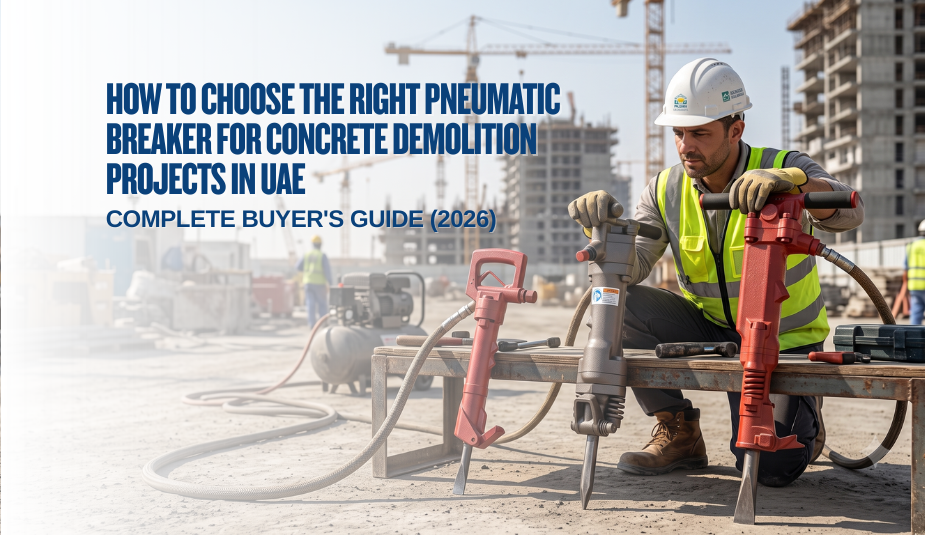
Concrete demolition is one of the most demanding tasks in construction. Whether it is breaking reinforced concrete foundations, removing old road surfaces, repairing industrial floors, or carrying out structural demolition, choosing the right equipment directly affects productivity, project timelines, and operating costs.
Over the years, working with construction companies, contractors, and industrial customers in the UAE, we have seen one common mistake: selecting demolition equipment based only on the purchase price.
A cheaper breaker that struggles with the application can quickly become more expensive due to slow progress, frequent breakdowns, and increased downtime.
At Liberty Enterprises LLC, we supply industrial equipment to construction, marine, infrastructure, and maintenance companies across the UAE. Through our experience supplying pneumatic demolition tools, we have learned that the correct breaker selection always starts with understanding the job requirements first.
A pneumatic breaker that works perfectly for a small maintenance task may not be suitable for a major concrete demolition project.
This guide explains the important factors contractors and procurement teams should consider before selecting a pneumatic breaker for concrete demolition projects in UAE.
A pneumatic breaker, also known as a pneumatic jack hammer, air breaker, or paving breaker, is a heavy-duty demolition tool powered by compressed air from an air compressor.
Unlike electric demolition hammers, pneumatic breakers are designed for demanding applications where continuous impact power and durability are required.
They are widely used in:
In the UAE, where large infrastructure projects, commercial developments, and industrial facilities require reliable equipment, pneumatic breakers remain one of the preferred choices among professional contractors.
You can explore our complete range of Pneumatic Breakers designed for different demolition applications and working conditions.
The first step is identifying the exact application.
Not every concrete demolition project requires the largest or most powerful breaker.
The right tool depends on:
For example, removing a thin concrete slab during maintenance work requires a different tool compared to breaking reinforced foundations at a large construction site.
A common mistake is selecting equipment based only on weight or impact force without considering the actual application.
Professional contractors usually evaluate the complete working environment before choosing a model.
Pneumatic breakers are available in different sizes, from lightweight chipping hammers to heavy-duty paving breakers.
The weight of the breaker plays an important role in performance and operator control.
Lightweight models are suitable for:
For lighter excavation and clay digging applications, a compact pneumatic tool such as the ACE CD222 Clay Digger can provide excellent performance while remaining easier to handle.
It is suitable for applications where a full-size paving breaker would be unnecessary.
For professional demolition work, contractors usually require heavier breakers capable of handling continuous operation.
Heavy-duty models are preferred for:
The ACE PB1230 Paving Breaker is designed for demanding construction applications where reliable impact performance and durability are required.
One of the most important factors when selecting a pneumatic breaker is ensuring your compressor can supply sufficient air.
A pneumatic breaker depends completely on compressed air availability.
Before purchasing, check:
An undersized compressor can reduce breaker performance significantly.
The tool may appear powerful on paper, but without adequate airflow, productivity will decrease.
For large construction sites in UAE, this is usually less of a concern because compressors are already used for other pneumatic equipment. However, smaller contractors should carefully evaluate compressor requirements before selecting a pneumatic breaker.
Construction conditions in the UAE can be challenging.
High temperatures, dust, long working hours, and demanding site conditions require equipment that can handle continuous use.
For projects in Dubai, Abu Dhabi, Sharjah, and other industrial areas, contractors often prioritize:
This is one reason pneumatic breakers continue to be popular for heavy construction applications.
They are built with fewer electrical components and are better suited for harsh working environments where equipment is exposed to dust, vibration, and continuous operation.
The breaker itself is only one part of the demolition system.
The correct chisel selection has a major impact on performance.
Common breaker accessories include:
Using the wrong chisel can reduce productivity and increase wear on both the tool and accessory.
Experienced contractors usually select the breaker and accessories together based on the material being removed.
For professional contractors, buying equipment is not the end of the decision.
After-sales support matters.
A machine sitting idle because of a missing spare part can delay an entire project.
When selecting a pneumatic breaker supplier in UAE, consider:
At Liberty Enterprises LLC, we focus not only on supplying industrial equipment but also supporting customers after purchase through technical assistance and servicing.
For heavy demolition applications, equipment reliability and supplier support are equally important.
Once the application, compressor requirements, and working conditions are understood, the next step is selecting the right breaker model.
Different projects require different levels of impact energy, durability, and operator control.
At Liberty Enterprises LLC, we generally recommend contractors choose equipment based on the actual working requirement rather than simply selecting the biggest model available.
A larger breaker is not always the best solution.
The ideal pneumatic breaker should provide enough power to complete the job efficiently while still allowing operators to work safely and productively.
For large-scale demolition projects involving reinforced concrete, roads, foundations, and industrial structures, contractors typically require heavy-duty paving breakers.
These applications demand:
The ACE PB1240 Paving Breaker is designed for these demanding applications.
It is suitable for contractors handling:
For companies where productivity and equipment uptime directly affect project costs, investing in a reliable heavy-duty breaker can significantly improve overall efficiency.
Not every project requires maximum impact power.
Many contractors work on applications where a balance between power, portability, and operator comfort is more important.
Medium-duty breakers are commonly used for:
The ACE PB1230 Paving Breaker provides a practical solution for contractors who require dependable pneumatic performance without moving into the largest equipment category.
Selecting the correct size helps operators maintain better control while still achieving efficient concrete removal.
Some demolition tasks require a smaller and more manageable pneumatic tool.
Examples include:
For these applications, lightweight pneumatic tools provide better handling and reduce operator fatigue.
The ACE CD222 Clay Digger is an example of a compact pneumatic tool designed for excavation and lighter-duty applications where flexibility and control are important.
The UAE construction sector includes some of the most demanding applications for demolition equipment.
From infrastructure development to industrial expansion, contractors require tools that can perform consistently under challenging conditions.
Road contractors frequently use pneumatic paving breakers for:
For these applications, a reliable paving breaker helps reduce project delays and improves productivity.
Breaking reinforced concrete requires consistent impact energy.
Applications include:
Pneumatic breakers are preferred in many of these environments because they are designed for continuous heavy-duty operation.
Industrial shutdown projects often operate under strict deadlines.
Equipment failure during a shutdown can create significant financial losses.
For these applications, contractors usually prioritize:
This is where professional-grade pneumatic equipment provides a major advantage.
One of the most common mistakes is selecting the cheapest available breaker.
While initial cost is important, professional buyers should also consider:
A low-cost tool that frequently stops working can become more expensive over the life of a project.
A smaller breaker may appear easier to purchase and operate, but using it for applications beyond its capacity can result in:
Choosing the correct breaker size from the beginning helps avoid these issues.
Even the best pneumatic breaker requires proper maintenance.
Regular maintenance practices include:
Proper maintenance extends equipment life and ensures consistent performance.
Construction environments in the UAE can expose equipment to dust, heat, and demanding working conditions.
To maintain reliable performance:
Pneumatic breakers require continuous lubrication to protect internal moving components.
Incorrect lubrication can increase wear and reduce tool life.
Always check:
Poor air quality or leaks can negatively affect breaker performance.
A worn chisel reduces impact efficiency and forces the operator to apply additional pressure.
Replacing worn accessories improves productivity and reduces unnecessary stress on the breaker.
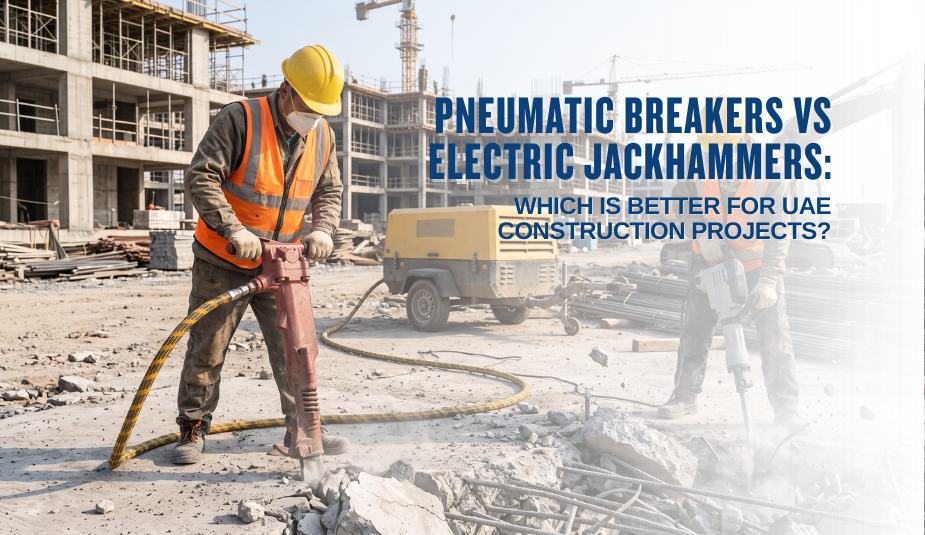
A common question from contractors is whether they should choose a pneumatic breaker or an electric jackhammer.
The answer depends on the project.
For professional contractors handling demanding projects, pneumatic breakers often provide better long-term value because they are designed for continuous industrial use.
The required breaker size depends on concrete thickness, reinforcement level, project duration, and available compressor capacity. Heavy reinforced concrete requires a larger paving breaker, while smaller repair jobs can use lightweight models.
Yes. Pneumatic breakers are widely used for reinforced concrete demolition because they provide consistent impact performance and are designed for heavy-duty applications.
In many construction applications, jack hammer and pneumatic breaker refer to similar types of demolition tools. The term used often depends on region and industry preference. Pneumatic breakers specifically refer to tools powered by compressed air.
Yes. Pneumatic breakers operate using compressed air supplied by a suitable compressor. The compressor must provide adequate airflow and pressure for efficient operation.
Road construction applications usually require heavy-duty paving breakers capable of handling asphalt and concrete removal. Models such as the ACE PB1240 are designed for these demanding conditions.
Choosing the right pneumatic breaker is not simply about selecting the most powerful machine.
It is about matching the equipment to the application.
Before purchasing, contractors should evaluate:
For UAE construction, infrastructure, and industrial projects, pneumatic breakers remain one of the most reliable solutions for heavy concrete demolition.
At Liberty Enterprises LLC, we help contractors, engineers, and procurement teams select the right demolition equipment based on their actual site requirements.
Whether you need a heavy-duty paving breaker for reinforced concrete, a medium-duty solution for general construction work, or a lightweight pneumatic tool for specialised applications, our team can help you choose the right equipment for your project.
Explore our range of Pneumatic Breakers or contact Liberty Enterprises LLC for technical guidance and equipment support for your next demolition project in UAE.

One Response